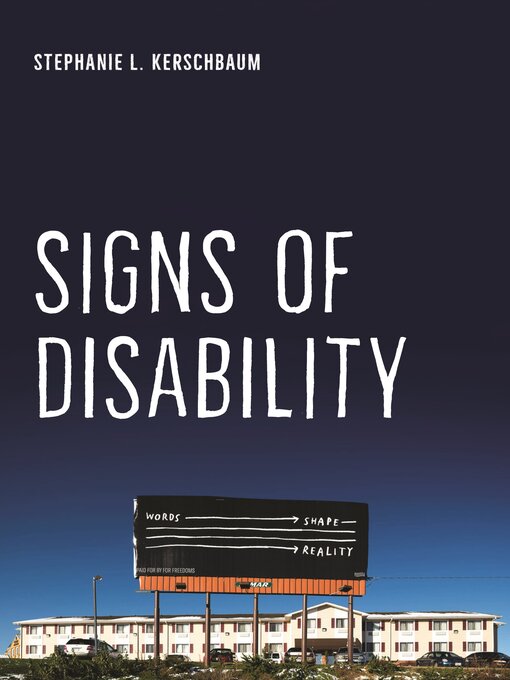
How can we learn to notice the signs of disability?
We see indications of disability everywhere: yellow diamond-shaped "deaf person in area" road signs, the telltale shapes of hearing aids, or white-tipped canes sweeping across footpaths. But even though the signs are ubiquitous, Stephanie L. Kerschbaum argues that disability may still not be perceived due to a process she terms "dis-attention."
To tell better stories of disability, this multidisciplinary work turns to rhetoric, communications, sociology, and phenomenology to understand the processes by which the material world becomes sensory input that then passes through perceptual apparatuses to materialize phenomena—including disability. By adding perception to the understanding of disability's materialization, Kerschbaum significantly expands our understanding of disability, accounting for its fluctuations and transformations in the semiotics of everyday life.
Drawing on a set of thirty-three research interviews focused on disabled faculty members' experiences with disability disclosure, as well as written narratives by disabled people, this book argues for the materiality of narrative, suggesting narratives as a means by which people enact boundaries around phenomena and determine their properties. Signs of Disability offers strategies and practices for challenging problematic and pervasive forms of "dis-attention" and proposes a new theoretical model for understanding disability in social, rhetorical, and material settings.
- Available now
- Newly Added eBooks
- Most popular
- Newly Added Kids
- Newly Added Teen eBooks
- Try something different
- Read a Classic
- See all ebooks collections
- Available now
- Newly Added Audiobooks
- Most popular
- Newly Added Kids Audiobooks
- Newly Added Teen Audiobooks
- Hidden Gems
- See all audiobooks collections